In short: most business loan rejections in India are not caused by a weak business. They are caused by weak CMA data, a low CIBIL score or rank, and GST, ITR and bank statement figures that do not agree with each other. Fix those three and the odds change sharply.
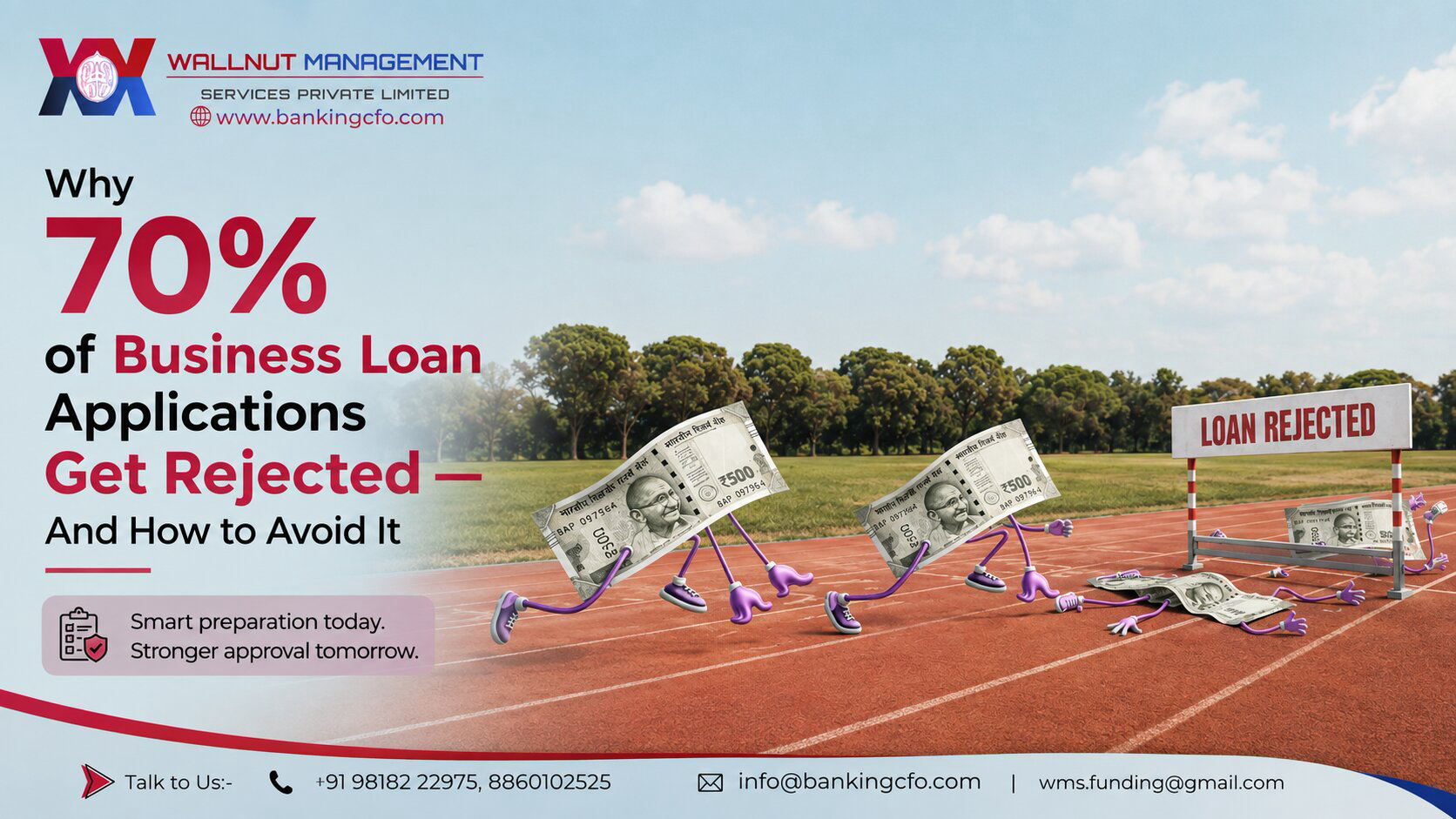
Ask ten SME owners about their business loan experience, and at least a few will tell you the same story: a strong business, healthy orders, and yet a loan application that went nowhere. "70% of applications get rejected" is a number quoted across small-business lending surveys worldwide — and while the exact figure shifts depending on which report you read, the underlying reality doesn't: most rejections aren't about a bad business.
They're about a badly prepared application.
In this guide, we look at the real, sourced data on business loan rejections, break down the actual reasons banks say no, and give you a practical checklist to fix your application before you submit it — not after it bounces back.
How Common Is Loan Rejection, Really? The Data
Rejection numbers vary widely depending on the source, the lender type, and how "rejection" is defined — so it's worth looking at more than one report rather than one headline figure. Here is what the most recent, credible data shows:
|
Source |
Key Finding |
|
TransUnion CIBIL x SIDBI, MSME Pulse Report (Jul 2026) |
Only 41% of India's 8.7 crore registered MSMEs have ever accessed formal credit as of March 2026 — the rest are either rejected, deterred, or have never formally applied. |
|
SIDBI-CRISIL Report (2025) |
India's MSMEs face an estimated formal credit gap of Rs 30 lakh crore, despite contributing roughly 30% of GDP and 46% of exports. |
|
SIDBI, "Understanding Indian MSME Sector" (May 2025) |
Of surveyed MSMEs seeking credit, 13% were declined for insufficient collateral, 14% cited limited credit history as a barrier, and 22% were discouraged by high interest rates before even applying. |
|
Business Standard, reporting PSB digital-lending data (Dec 2025) |
Public sector banks processed 5,60,655 MSME applications between Apr-Oct FY26; 2,61,281 were sanctioned. The reported overall rejection rate across banks was about 20%, varying sharply by lender. |
|
SCORE.org (US small-business lending surveys) |
Denial rates for small-business bank financing range from 70% to 90% depending on the survey — a reminder that rejection rates vary hugely by lender type, loan size, and applicant preparedness. |
The pattern across every one of these reports is consistent: formal, well-documented, bank-ready applications get approved at a far higher rate than informal or hastily prepared ones. The "70%" figure many business owners fear isn't a fixed statistic — it reflects what tends to happen to applicants who go in unprepared, without professional CMA data, a clean credit history, or a properly structured proposal.
Top Reasons Business Loan Applications Get Rejected
Across CGTMSE-backed loans, working capital limits, and term loans, the same handful of issues show up again and again:
- Weak or missing CMA data —
Banks assess repayment capacity using Credit Monitoring Arrangement (CMA) data. Generic, inconsistent, or unrealistic projections are one of the most common rejection triggers. - Low CIBIL score or CIBIL Rank —
Individual applicants are typically expected to maintain a score above 700; for businesses, a CIBIL Rank of 8 or above often results in automatic rejection regardless of performance. - GST, ITR, and bank statement mismatches —
If your filed turnover, GST returns, and bank credits don't tell the same story, underwriters flag it immediately. - No detailed project report (DPR) —
Especially for new businesses or expansion loans, a thin or templated DPR without market feasibility and clear fund-usage plans raises doubt. - Insufficient or overvalued collateral —
Lenders typically finance up to 60-70% of a pledged asset's value; a mismatch between your requirement and your collateral value leads to a straight decline. - High FOIR or weak DSCR —
If a large share of income is already committed to existing EMIs, or your Debt Service Coverage Ratio falls below the lender's threshold (commonly 1.25x), approval becomes difficult. - Informal, cash-heavy operations —
Businesses that route a large share of revenue outside the banking system struggle to prove repayment capacity on paper, even when the business is genuinely profitable. - Vague fund-usage plans —
"We need funds to grow" isn't a plan. Lenders want precise, itemised deployment of the loan amount.
CGTMSE-Backed Applications Face Different Odds :-
Collateral-free lending under the Credit Guarantee Fund Trust for Micro and Small Enterprises (CGTMSE) is meant to remove the biggest single barrier — lack of security — but it doesn't remove underwriting scrutiny. If anything, banks tend to apply extra care with CGTMSE files precisely because the government guarantee shifts some risk onto the scheme itself. Applicants with less than 2-3 years of vintage, or with a CIBIL score below roughly 650, are still likely to face rejection even with CGTMSE cover, unless the project report and cash-flow projections are unusually strong. The fix isn't to avoid CGTMSE-backed limits — it's to treat the documentation with the same rigour as a fully secured loan, not less.
Preparation Changes the Odds — Significantly
This is the part most business owners underestimate. A well-documented, properly structured application doesn't just look better — it converts at a materially higher rate.
|
Application Type |
What Typically Happens |
|
Unprepared / first-time, no CMA data, weak DPR |
Falls into the higher-rejection band seen across informal and undocumented MSME applications (SIDBI data above). |
|
Documented but incomplete (gaps in GST/ITR match) |
Frequently delayed, returned for clarification, or rejected without a formal rejection order — a pattern noted in SIDBI-collated CGTMSE data. |
|
Fully prepared: accurate CMA data, clean CIBIL, DPR, consistent filings |
Falls into the lower-rejection band; industry practitioners report that thorough preparation can cut rejection risk by well over 70% relative to an unprepared application. |
In other words, the single biggest lever you control isn't your business size or your collateral — it's how professionally your application is prepared and presented.
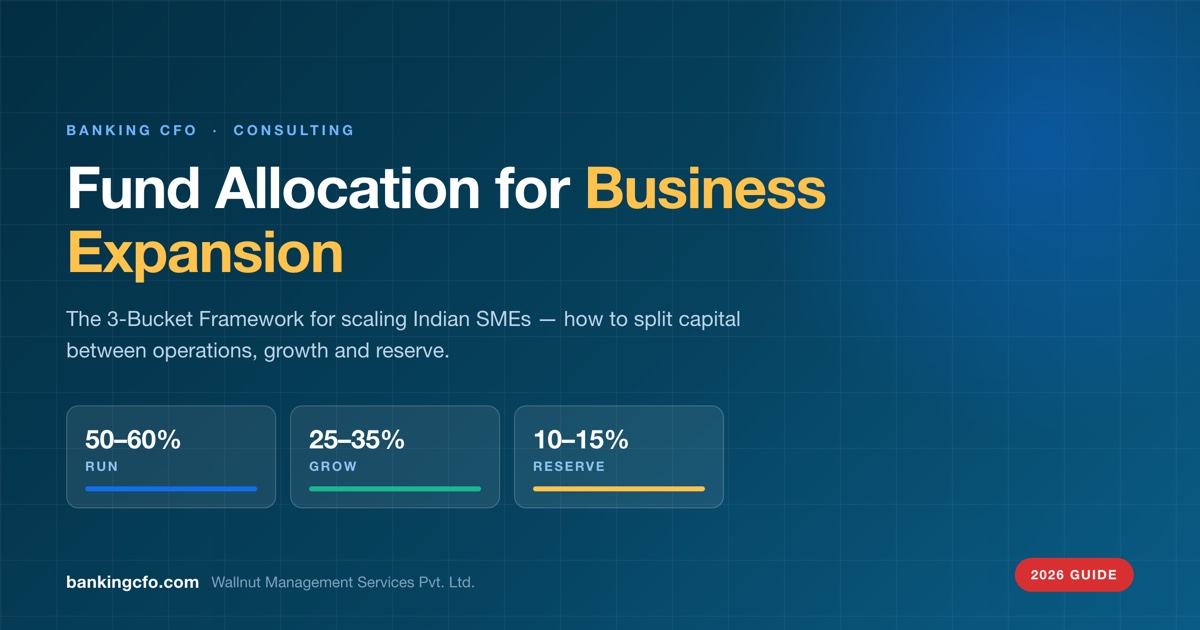
And once the sanction comes through, the next question is how to deploy it. Our guide to fund allocation for business expansion sets out how a scaling business should split capital between operations, expansion and reserve.
How to Avoid Rejection: A Practical Checklist
- Get your CIBIL score (and CIBIL Rank, if applicable) checked before applying — not after a rejection.
- Prepare accurate, bank-format CMA data that reflects realistic sales, inventory, and receivable cycles.
- Keep GST filings, ITR, and bank statement turnover consistent with each other.
- Build a proper Detailed Project Report (DPR) for any project, term, or expansion loan — not a generic template.
- Match your loan request to your actual collateral value and repayment capacity (DSCR/FOIR).
- Route business transactions through your business bank account consistently, well before you apply.
- Avoid applying to multiple lenders simultaneously in a short window — each hard inquiry can nudge your score down.
- Where you lack collateral, explore CGTMSE-backed limits instead of assuming automatic rejection.
How Banking CFO Helps You Get Approved :-
This is exactly the gap Banking CFO (Wallnut Management Services Pvt. Ltd.) is built to close. Instead of leaving SME owners to navigate CMA data, DPR preparation, and bank liaison alone, our Shared Banking CFO model manages the entire cycle — sanction, renewal, and post-disbursement compliance — as an outsourced, ongoing function.
Our services directly address the top rejection triggers covered above:
- Professional CMA data and stock statement preparation matched to your actual operating cycle
- Detailed Project Report (DPR) preparation for term loans, project financing, and expansion funding
- Direct liaison with banks for Working Capital, Cash Credit/Overdraft, Term Loans, LC, BG, and CGTMSE-backed limits
- Renewal and enhancement of existing bank limits, so you're not caught off guard at review time
- Ongoing monitoring of interest levy, bank charges, and sanction-term compliance
We work across a wide banking and NBFC partner network — including RBL Bank, Bajaj Finserv, Aditya Birla Finance, Canara Bank, Deutsche Bank, IDFC First Bank, IndusInd Bank, AU Small Finance Bank, Kotak Bank, and Union Bank of India — which means your application goes to the lender most likely to say yes, structured the way that lender expects to see it.
Frequently Asked Questions
Q1. Is it true that 70% of business loans get rejected in India?
Recent India-specific data from public sector banks' digital lending model shows an overall rejection rate closer to 20%, while other studies show 13-28% of MSMEs facing rejection for specific reasons like collateral or credit history. The higher 70-90% range comes from global small-business lending surveys and typically reflects unprepared or undocumented applications rather than the baseline rate for all applicants.
Q2. What's the single biggest reason business loans get rejected?
There's no single cause, but weak or inconsistent CMA data — combined with mismatched GST/ITR/bank statement figures — is one of the most frequently cited reasons across CGTMSE and working capital rejections.
Q3. Can a rejected loan application be reapplied successfully?
Yes, in most cases. Rejection is rarely final — correcting the specific issue (credit score, documentation, DPR quality, or collateral mismatch) and reapplying through a properly structured proposal significantly improves approval odds.
Q4. How long does it take to fix a weak loan application?
It depends on the gap. CIBIL corrections can take a few weeks to reflect; CMA data and DPR preparation, when handled professionally, typically takes a few days once financials and filings are in order.
Q5. Does a CGTMSE guarantee remove the need for good documentation?
No. CGTMSE removes the collateral requirement, not the underwriting check. Banks still assess CIBIL score, business vintage, and the quality of your CMA data and project report before approving a CGTMSE-backed limit.
Sources & References
- TransUnion CIBIL x SIDBI, MSME Pulse Report, July 2026 (as reported by Deccan Chronicle, SMEVenture).
- SIDBI-CRISIL MSME Credit Gap analysis, 2025 (as reported by YourStory).
- SIDBI, "Understanding Indian MSME Sector: Progress and Challenges," May 2025 (sidbi.in).
- Business Standard, "Public-sector banks okay Rs 28k cr in MSME loans via new digital model," Dec 25, 2025.
- SCORE.org, "My Loan Application Was Rejected. What's Next?"
- NIIR / SIDBI-collated CGTMSE rejection-reason data (niir.org)