Most Indian SMEs do not fail because they could not raise money. They fail because of what they did with it after it arrived.
A business doing ₹4 crore decides to go to ₹10 crore. It buys a second machine, takes a bigger godown, hires a sales team and pushes for larger orders. Twelve months later the order book is full, the P&L shows profit — and there is no money in the current account to pay next week's supplier. Nothing about the expansion was wrong. The fund allocation was.
Growth consumes cash before it produces cash. Every additional rupee of sales drags along more inventory, more receivables and more fixed cost, and all three are funded today while the margin arrives months later. That is why scaling is, at its core, an allocation problem rather than a fundraising problem.
This guide gives you a working CFO framework for fund allocation for business expansion: how to split capital across operations, growth and reserve, how to match the right banking instrument to each need, and how to calculate what your business actually requires before you approach a lender.
Key takeaways
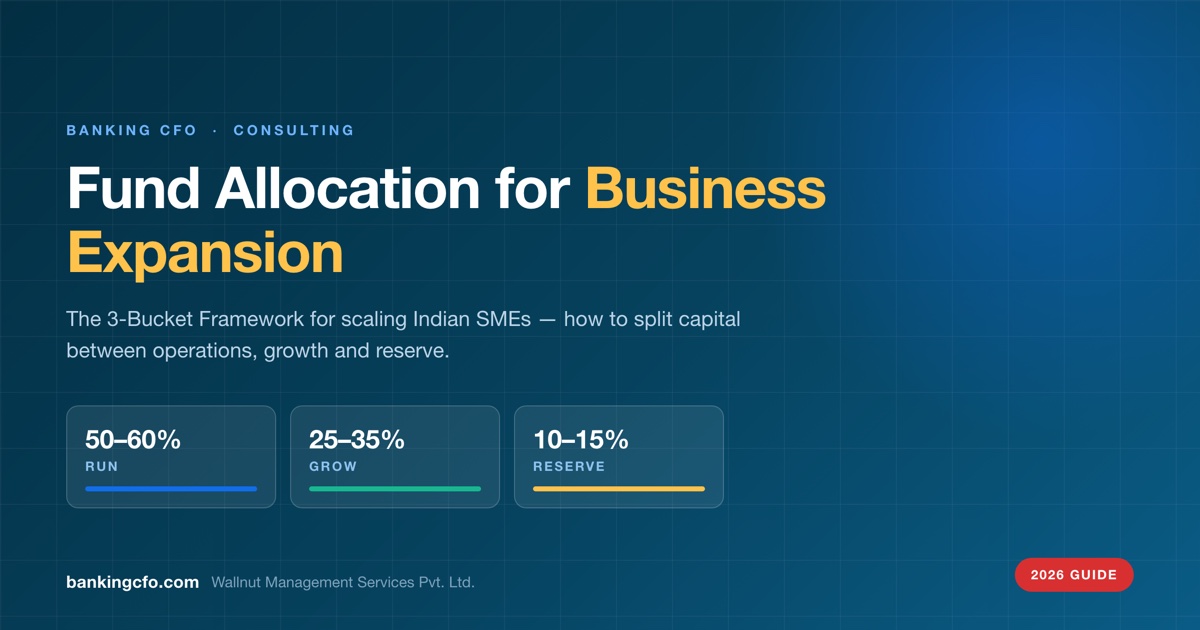
- Allocate deployable capital roughly 50–60% to Run, 25–35% to Grow, 10–15% to Reserve — and fund Grow only after Run is covered.
- Match the tenor to the asset. Machinery on a cash credit limit is the most expensive mistake in Indian SME finance.
- Fix the cash conversion cycle before borrowing. Indian SMEs wait an average of 73 days for invoice payment; cutting 15 days off the cycle can release more cash than a fresh loan.
- Expansion funding is approved on documentation quality — CMA data, DPR and consistent filings — not on ambition.
Why Profitable Businesses Still Run Out of Cash While Scaling
There is a specific trap that catches growing businesses, and it has a name: the growth cash gap. When turnover rises, three things happen at once, and all three are cash outflows.
- Inventory rises before sales do. You stock up to service the larger order, and that money leaves your account weeks before the invoice is even raised.
- Receivables rise with revenue. Bigger customers pay slower, not faster. Larger buyers negotiate longer credit periods as a condition of the order.
- Fixed costs step up, not creep up. A new unit, a new supervisor or a second shift is a block cost that starts immediately and pays back gradually.
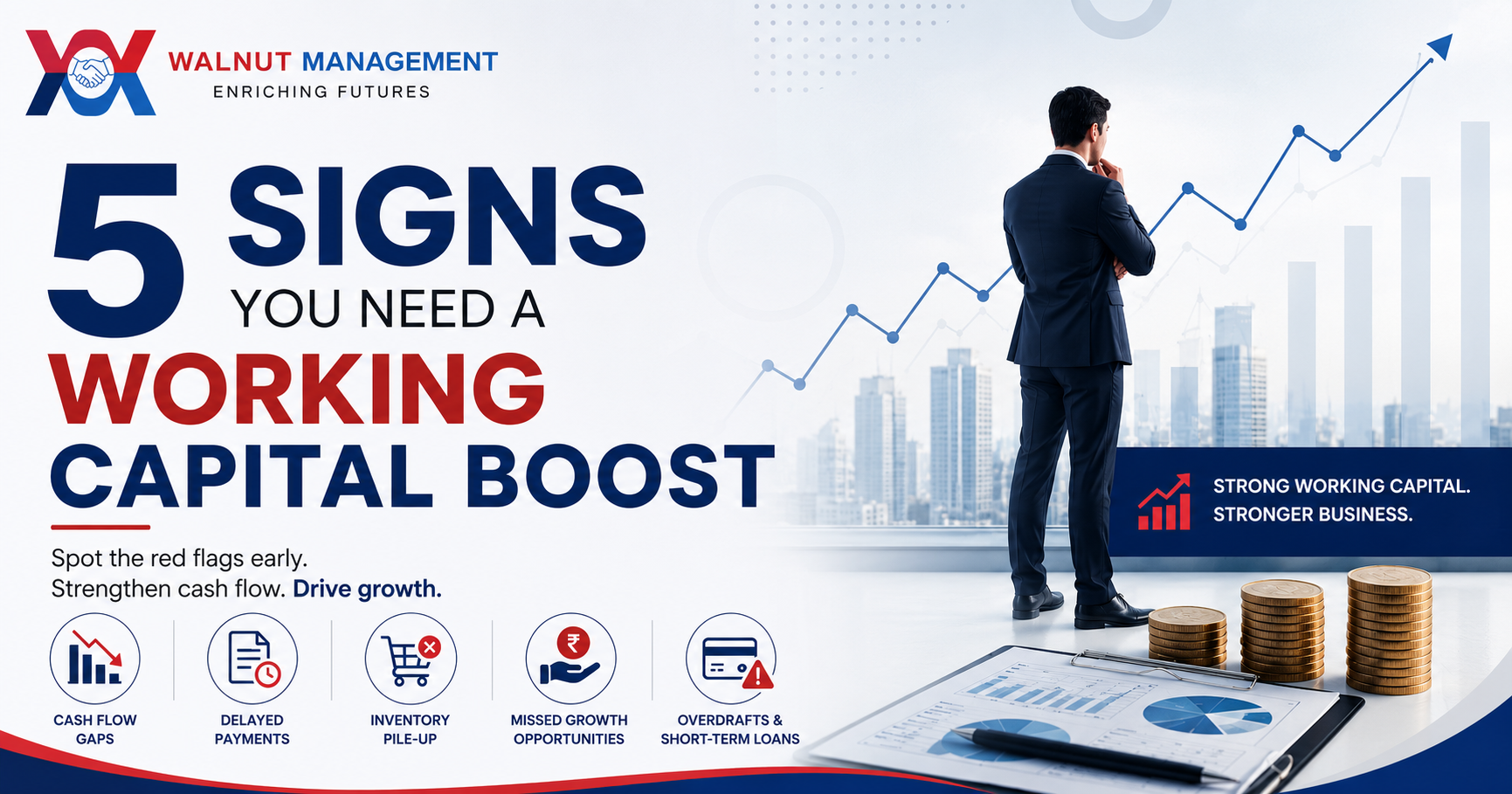
Meanwhile the profit on those extra sales arrives only after the full cycle completes. So the business is simultaneously more profitable on paper and more cash-starved in reality — which is exactly when owners start diverting working capital into expansion, or expansion funds into salaries. If your business is already showing these strains, our guide on the 5 signs your business needs a working capital boost sets out the early warning signals in detail.
The Numbers Behind India's SME Growth-Capital Squeeze
Fund allocation decisions in India are not made in a vacuum. They are made inside a credit environment with specific, documented constraints. Here is what the most recent data shows:
| Source | What it means for your allocation |
|---|---|
| SIDBI–CRISIL MSME credit gap analysis (2025) | An estimated ₹30 lakh crore formal credit gap in Indian MSMEs. Assume capital will be scarcer and slower than your plan expects — build the buffer in. |
| TransUnion CIBIL × SIDBI, MSME Pulse (July 2026) | Only about 41% of India's 8.7 crore registered MSMEs have ever accessed formal credit. Most expansions are still being funded from the operating account — the single biggest allocation error. |
| Recordent, Indian SME Receivables Report 2026 | Average invoice settlement of 73 days, and an average of about ₹3.83 crore per SME in receivables overdue beyond 360 days. Your receivables cycle, not your sales target, sets your working capital requirement. |
| MSME Samadhaan data, as of 14 August 2026 (via CRISIL) | 2,56,892 delayed-payment applications worth ₹55,244 crore, with ₹20,979 crore still pending. Delay is structural, not exceptional — reserve for it. |
| Union Cabinet approval, 6 October 2026 | A ₹10,000 crore SME Growth Fund, structured as an AIF providing direct equity to growth-stage SMEs, with priority to manufacturing and Tier-II/Tier-III clusters. Equity for expansion is becoming a genuine third option alongside debt and own funds. |
Read together, these tell a consistent story: credit is available but rationed, payment cycles are long and lengthening, and the businesses that scale successfully are the ones that plan their capital structure rather than react to it.
The 3-Bucket Fund Allocation Framework
The framework below is the one we apply when we sit down with an SME planning an expansion. It is deliberately simple, because allocation discipline fails when the model is complicated.
Start with your deployable capital — the total of sanctioned limits, fresh funding, promoter contribution and retained surplus you can actually commit over the next 12 months. Then split it three ways.
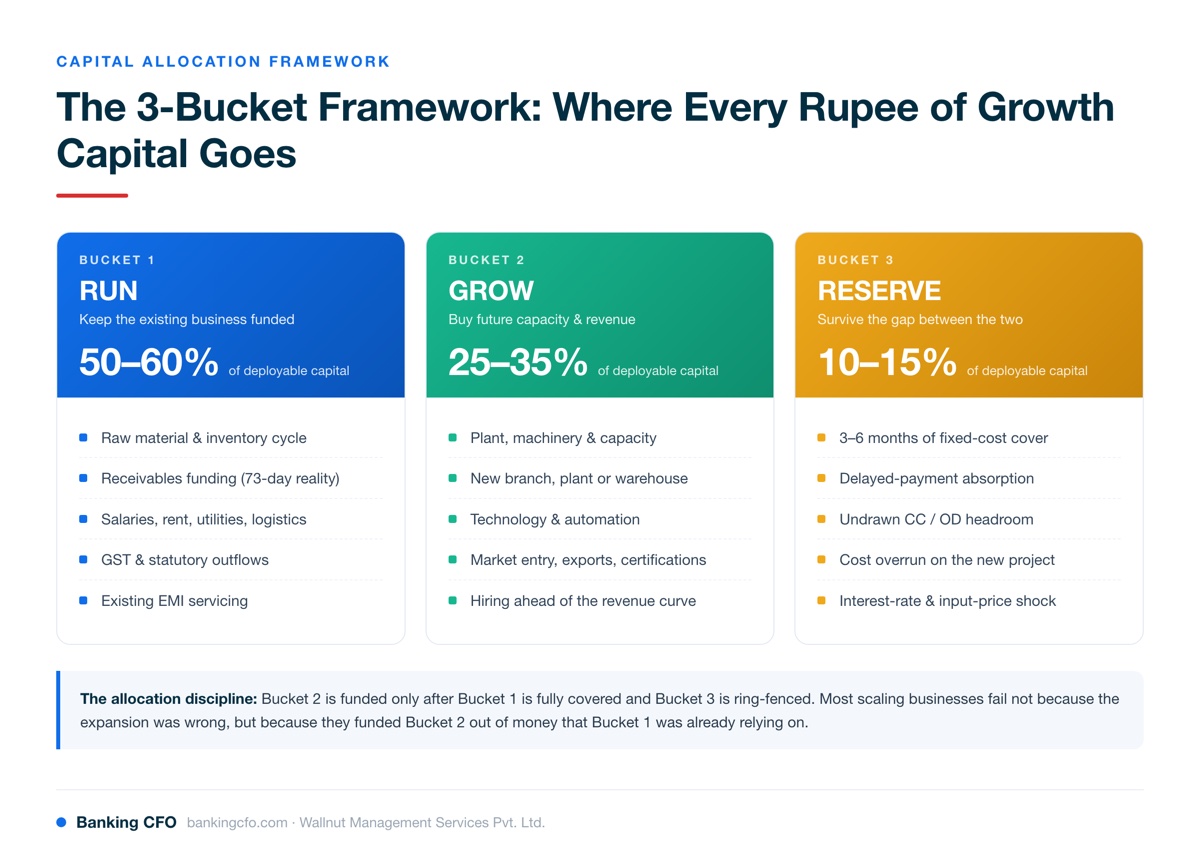
Bucket 1 — RUN: 50–60% of deployable capital
This funds the business you already have. Raw material and inventory, the receivables gap, salaries, rent, power, freight, GST and statutory outflows, and servicing of existing EMIs. It is unglamorous and it is non-negotiable.
The number that matters here is not a percentage but a calculation: your operating cycle multiplied by your daily cost of operations. A business with an 81-day cash conversion cycle on ₹6 crore of turnover has roughly ₹1.33 crore permanently locked in Bucket 1. That money is not available for expansion, no matter what the balance sheet says about reserves. The right instruments here are a working capital loan or a cash credit / overdraft limit, sized to the cycle.
Bucket 2 — GROW: 25–35% of deployable capital
This buys future capacity: plant and machinery, a new unit or warehouse, technology and automation, export certifications and market entry, and hiring ahead of the revenue curve.
Bucket 2 has one rule attached to it. Every rupee in it must have a stated payback period and a stated funding source before it is spent. "We will buy the machine and the orders will follow" is not a plan; "this machine adds 30% capacity, breaks even at 62% utilisation, is funded by a 5-year term loan / machinery loan and services its own EMI from month four" is. For a full new unit or a greenfield line, project financing with a properly built DPR is the correct route, not an enhancement of the existing limit.
Bucket 3 — RESERVE: 10–15% of deployable capital
This is the bucket most SMEs skip, and it is the one that decides whether a bad quarter is survivable. It should cover three to six months of fixed costs, absorb delayed payments, and leave undrawn headroom on your CC/OD limit.
A reserve is not idle money. Undrawn limit headroom costs you very little, preserves your account conduct with the bank, and is the difference between negotiating from strength and accepting whatever terms are available when you are desperate. Given the ₹55,244 crore of delayed MSME payments already in dispute nationally, treating the reserve as optional is a bet against the base rate.
The allocation discipline: fund Bucket 2 only after Bucket 1 is fully covered and Bucket 3 is ring-fenced. Most scaling businesses do not fail because the expansion was wrong — they fail because they funded Bucket 2 out of money that Bucket 1 was already relying on.
A worked example: allocating ₹1 crore
A fabrication unit with ₹6 crore turnover raises ₹1 crore of deployable capital for an expansion. Here is the difference between the two approaches we see most often:
| Allocation | The usual approach | The 3-Bucket approach |
|---|---|---|
| Run | ₹20 lakh — "we'll manage from sales" | ₹55 lakh — sized to an 81-day cycle |
| Grow | ₹80 lakh — machine bought outright | ₹32 lakh margin money on a ₹80 lakh machinery term loan |
| Reserve | ₹0 | ₹13 lakh + undrawn CC headroom |
| Outcome at month 9 | Machine installed, orders won, supplier payments delayed, CC limit fully drawn, no cushion | Same machine, same orders, EMI serviced from operations, limit headroom intact |
The second business did not raise more money. It allocated the same ₹1 crore differently — and used a term loan to do what a term loan is designed to do.
The Tenor-Matching Rule: Match the Instrument to the Life of the Asset
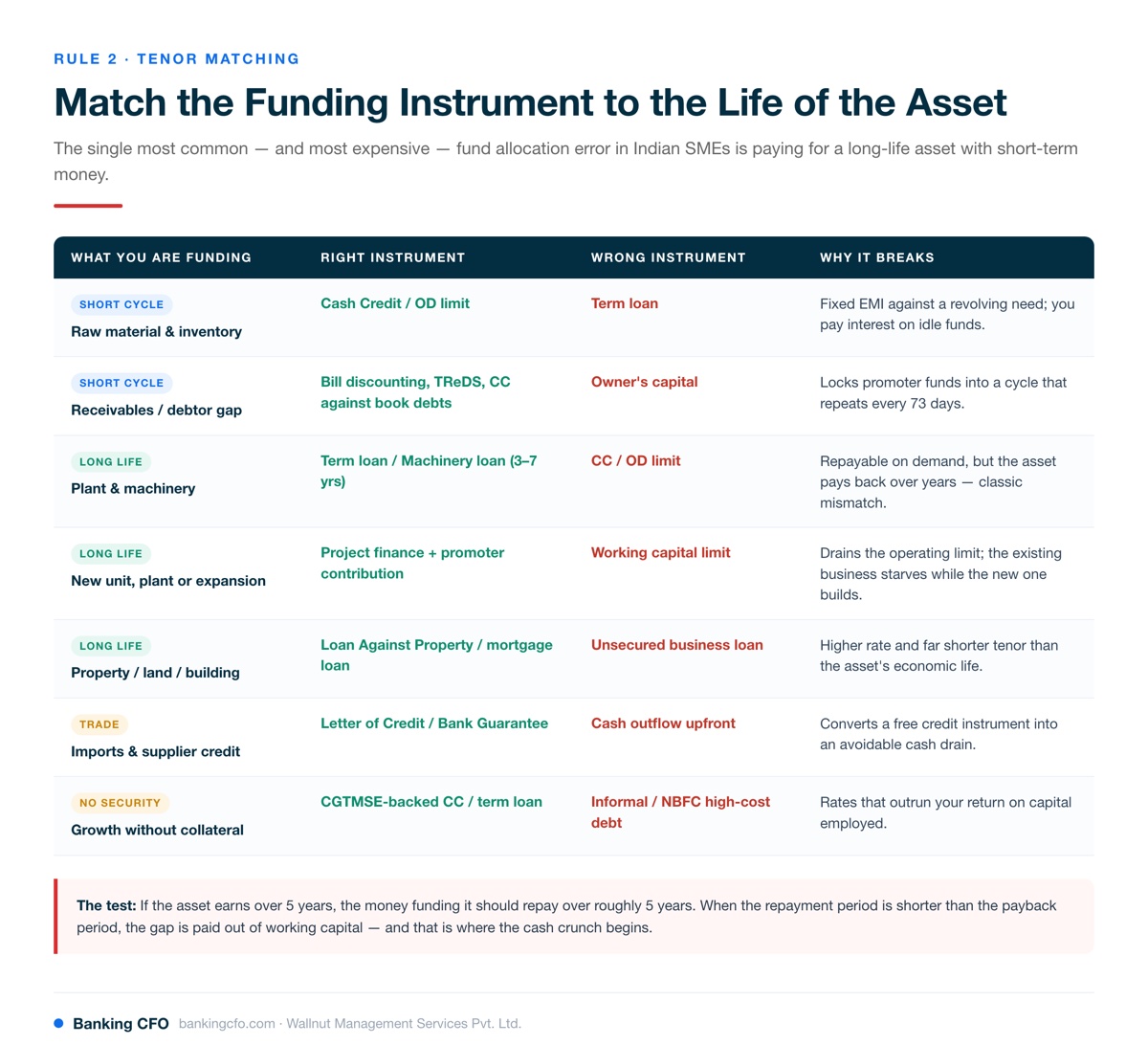
If you take only one operating rule from this article, take this one. The repayment period of the money should roughly match the payback period of the asset it funds. When repayment is faster than payback, the shortfall comes out of working capital — and that is where the cash crunch starts.
In practice this means a few specific things:
- Never fund machinery from a cash credit limit. A CC limit is repayable on demand and reviewed annually; a machine pays back over five to seven years. The mismatch is structural and it shows up at renewal.
- Never fund the receivables gap from promoter capital. That cycle repeats every 73 days. Fund it with a revolving instrument — CC against book debts, bill discounting or TReDS — and keep your own capital for margin money.
- Use trade instruments instead of cash wherever possible. A letter of credit or a bank guarantee lets you secure supply or win a tender without an upfront cash outflow. Many SMEs pay cash for what a credit instrument would have covered.
- If you lack collateral, use the scheme built for it. Since April 2026 the RBI's mandate makes loans up to ₹20 lakh to eligible micro and small enterprises collateral-free — see our explainer on collateral-free MSME loans up to ₹20 lakh — and CGTMSE-backed limits extend the principle further. High-cost informal borrowing to fund expansion almost always outruns the return on the asset.
Fix the Cash Conversion Cycle Before You Borrow for Growth
Before you decide how much expansion capital to raise, calculate how much you are currently losing to your own operating cycle. The formula is simple:
CCC = DIO + DSO − DPO | Working capital need ≈ (Annual turnover ÷ 365) × CCC
Where DIO is days inventory outstanding, DSO is days sales outstanding (your receivables), and DPO is days payable outstanding (credit your suppliers extend to you).
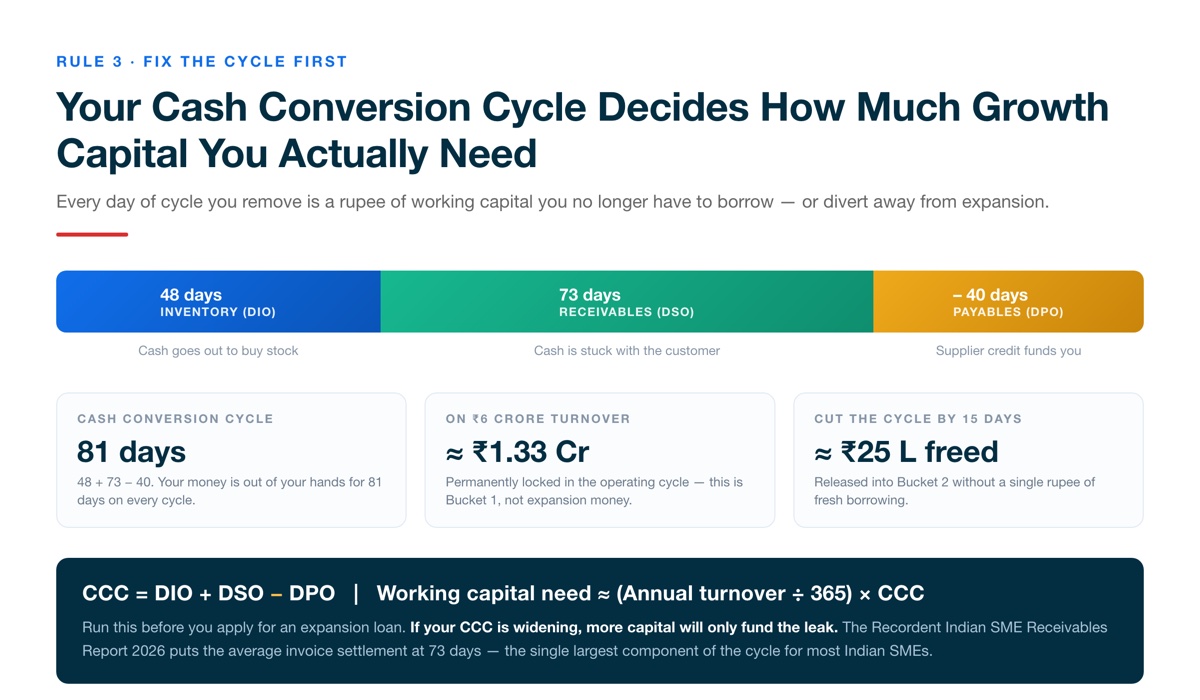
The leverage here is larger than most owners expect. On ₹6 crore of turnover, every single day removed from the cycle releases roughly ₹1.64 lakh of cash permanently. Pulling the cycle in by 15 days frees about ₹25 lakh — without a rupee of fresh borrowing, without interest cost, and without dilution.
Practical levers, in order of how quickly they usually work:
- Invoice the day of dispatch, not at month end. This alone often removes 8–12 days.
- Tighten credit terms by customer segment rather than across the board, and enforce them on the slowest 20% of debtors who typically account for most of the overdue value.
- Use the 45-day statutory protection. The MSME Development (Amendment) Bill 2026 strengthens the framework around delayed payments — register on Udyam and use MSME Samadhaan where buyers stall.
- Discount receivables selectively through TReDS for your large corporate buyers, where the cost of discounting is lower than the cost of a parallel working capital limit.
- Negotiate supplier credit deliberately, including LC-backed terms. Each extra day of DPO is a day less of borrowing.
- Clear slow-moving inventory even at a discount. Stock sitting for 120 days is a financing cost pretending to be an asset.
Run this calculation first. If your cycle is widening, additional capital will only fund the leak at a larger scale.
7 Fund Allocation Mistakes That Stall Scaling Businesses
- Funding capex from the working capital limit. The most common and most damaging. It looks free because the limit is already sanctioned, and it quietly starves the operating cycle.
- Allocating against the sales target instead of the collection reality. Plan on when cash arrives, not when the invoice is raised.
- Treating promoter capital as working capital. Own funds belong in margin money and equity contribution, where they unlock leverage, not in a revolving cycle.
- Keeping zero reserve. One delayed payment from a large buyer then becomes an emergency rather than an inconvenience.
- Expanding capacity before fixing the cycle. A longer cycle at a larger turnover multiplies the cash gap rather than adding to it.
- Applying for a limit enhancement without rebuilding the CMA data. Banks assess the projections, not the ambition. Weak CMA data is one of the most frequently cited rejection triggers — see why so many business loan applications get rejected.
- Single-banking a growing business. As limits grow, concentration becomes a constraint. Multiple banking or consortium arrangements need to be planned a year ahead, not negotiated in a crisis.
Your Pre-Expansion Capital Readiness Checklist
Work through this before you commit to an expansion or submit an application:
- Calculate your current cash conversion cycle and the working capital it locks up.
- Confirm your existing limit is correctly sized to the cycle, not to last year's turnover.
- Write the payback period and funding source for every item of capex before any order is placed.
- Check your DSCR against the proposed EMI — most lenders look for 1.25x or better.
- Check CIBIL score and CIBIL Rank before applying, not after a rejection.
- Reconcile GST returns, ITR and bank statement turnover so all three tell the same story.
- Prepare bank-format CMA data reflecting the real operating cycle, including the expansion year.
- Build a Detailed Project Report (DPR) for any project, term or expansion loan.
- Ring-fence the reserve bucket in writing before the first rupee of Bucket 2 is spent.
- Identify the right lender and the right product for each bucket — not one lender for everything.
How Banking CFO Helps You Allocate and Raise Growth Capital
Allocation decisions are easy to describe and hard to hold to, particularly when the owner is also running production, sales and collections. That is the gap our Shared Banking CFO model is built to close: an outsourced, ongoing CFO function for the banking and funding side of your business, rather than a one-time loan arrangement.
In the context of an expansion, that means:
- Sizing the limit to the actual operating cycle through professionally prepared CMA data and stock statements — so Bucket 1 is funded correctly from the start.
- Detailed Project Report preparation for term loans, machinery purchases and project financing, with feasibility and fund-usage mapped the way underwriters expect to see it.
- Structuring the right mix of instruments across working capital, CC/OD, term loans, LC, BG, export credit and CGTMSE-backed limits — each matched to its bucket.
- Renewal and enhancement of existing limits, planned ahead of review dates rather than scrambled at the deadline.
- Ongoing monitoring of interest levy, bank charges and sanction-term compliance, so the cost of capital you negotiated is the cost you actually pay.
We work across a wide banking and NBFC partner network — including RBL Bank, Bajaj Finserv, Aditya Birla Finance, Canara Bank, Deutsche Bank, IDFC First Bank, IndusInd Bank, AU Small Finance Bank, Kotak Bank and Union Bank of India — which means each requirement goes to the lender most likely to fund it, structured the way that lender expects. If you would rather talk it through than work through it alone, get in touch with our team.
Frequently Asked Questions
Q1. How should a growing business split its funds between operations and expansion?
As a working rule, allocate roughly 50–60% of deployable capital to operations (Run), 25–35% to expansion (Grow) and 10–15% to reserve. The Run figure should be calculated from your cash conversion cycle rather than taken as a percentage — a long receivables cycle pushes it higher and legitimately reduces what is available for expansion.
Q2. Can I use my working capital limit to fund machinery or a new unit?
You should not. A cash credit or overdraft limit is short-term, revolving and repayable on demand, while machinery and new units pay back over several years. Funding long-life assets from a working capital limit drains the operating cycle and usually surfaces as a problem at renewal. A term loan, machinery loan or project finance facility is the correct instrument.
Q3. How much working capital does a growing business actually need?
A practical estimate is (annual turnover ÷ 365) × your cash conversion cycle in days. A business with ₹6 crore turnover and an 81-day cycle needs roughly ₹1.33 crore in working capital. Recalculate it for your projected turnover, not your current one, before applying for an enhancement.
Q4. Should I fund expansion with debt or my own money?
Use your own funds as margin money and equity contribution, where they unlock bank leverage, and use matched-tenor debt for the asset itself. Consuming promoter capital on the operating cycle is the most common way SMEs end up both under-capitalised and under-leveraged at the same time. With the ₹10,000 crore SME Growth Fund approved in October 2026, equity is also becoming a realistic third route for growth-stage manufacturing and export-oriented firms — at the cost of dilution and greater governance scrutiny.
Q5. What is the fastest way to free up cash without borrowing?
Shorten the cash conversion cycle. Invoicing on dispatch, enforcing credit terms on the slowest debtors, discounting receivables through TReDS and negotiating supplier credit typically move the cycle faster than any new facility can be sanctioned. On ₹6 crore of turnover, 15 days off the cycle releases around ₹25 lakh.
Q6. When should I plan my expansion funding?
Begin six to nine months before the capital is required. CMA data, DPR preparation, CIBIL corrections, GST and ITR reconciliation, and bank appraisal all take time, and applications submitted in a hurry are the ones that get declined. Planning ahead also lets you negotiate rather than accept.
Q7. What is the difference between cash credit, overdraft and a term loan?
A cash credit limit is a revolving facility secured against stock and book debts, drawn and repaid as the operating cycle turns. An overdraft works the same way but is usually secured against property or a deposit rather than current assets. Both are short-term and reviewed annually. A term loan is a fixed-tenor facility repaid in instalments and is the correct instrument for machinery, equipment or a new unit. The practical rule is the tenor-matching rule above: use a CC or OD limit for the operating cycle, and a term loan for anything with a multi-year payback. Our cash credit and overdraft limit page explains how each is sanctioned and renewed.
Q8. How much of an expansion should be funded by the promoter?
For most term and project loans, banks expect a promoter contribution or margin money of roughly 25-35% of the project cost, with the balance financed. Treat that contribution as the main use of your own capital; funding the operating cycle out of promoter funds instead is what leaves growing businesses both under-capitalised and under-leveraged at the same time.
Sources & References
- SIDBI–CRISIL MSME credit gap analysis, 2025.
- TransUnion CIBIL × SIDBI, MSME Pulse Report, July 2026.
- Recordent, Indian SME Receivables Report 2026 (sample of approximately 1.1 lakh MSMEs).
- MSME Samadhaan delayed-payment data as of 14 August 2026, as reported by CRISIL.
- Union Cabinet approval of the ₹10,000 crore SME Growth Fund, 6 October 2026.
- Reserve Bank of India mandate on collateral-free lending to micro and small enterprises up to ₹20 lakh, effective 1 April 2026.
- Micro, Small and Medium Enterprises Development (Amendment) Bill, 2026.
Figures quoted are drawn from the sources above and from published reporting on them. Survey-based estimates use self-selected samples and should be read as indicative rather than exact. Allocation ranges in this article are practitioner guidance, not regulatory prescription, and should be adapted to your sector and operating cycle.
About the authors
This guide was prepared by the advisory team at Banking CFO — Wallnut Management Services Private Limited, which has worked as an outsourced banking CFO for SMEs across Delhi NCR since 2017. Our team has handled working capital sanctions, renewals, enhancements, CMA and DPR preparation, and post-disbursement compliance for 380+ clients and 750+ funding cases. The allocation ranges and failure patterns described here are drawn from that casework, not from theory.
Last updated: 21 October 2026.
Related reading: Why every SME needs a working capital loan consultant · Budgeting and spending plans · MSME loan schemes: a complete guide
.